A Guide to South Africa Online Advertising

By Chris Edington
Welcome to your roadmap for mastering online advertising in South Africa. Let's skip the generic, one-size-fits-all advice. This is a practical playbook, built from real-world experience, for businesses ready to grow in a unique and incredibly dynamic market.
Your Starting Point for Advertising in South Africa
Think of this as a chat with a seasoned strategist who’s been in the trenches. We’ll cut through the jargon and get straight to what actually works here—from understanding the subtle shifts in consumer behaviour to picking the platforms that will give you the best bang for your buck.
We’re here to show you why now is the perfect moment to invest in your digital presence and how to build a winning advertising strategy from the ground up, tailored specifically for South Africa. The key is to stop guessing and start making smart, data-driven decisions that respect local nuances.
Why the Timing Is Perfect
The numbers tell a compelling story. South Africa's online advertising market isn't just ticking along; it’s exploding. Revenue recently hit USD 3,150.5 million, and forecasts predict it will rocket to an incredible USD 8,342.1 million by 2030.
This growth is happening right alongside the eCommerce boom. The sector has already reached R96 billion in turnover and is on track to hit R130 billion, thanks to over 10.4 million online shoppers. You can dig deeper into these figures in the latest market outlook research from Grand View Research.
But it's not just about a bigger audience. It’s about a more engaged one. South African consumers are actively searching for products and services online, creating a perfect opportunity for smart, targeted advertising.
By understanding the specific dynamics of this market, you can position your brand to ride this wave, turning your ad spend into a powerful and predictable growth engine.
What You Will Learn
This guide is structured to give you a clear, actionable framework. We’ll walk through the essential pillars of a successful campaign so you can move forward with confidence.
Here’s a quick look at what’s on the agenda:
- Market Insights: We’ll break down the local digital scene, covering everything from crucial consumer habits to staying compliant with the POPI Act.
- Platform Strategy: You'll learn how to choose the right channels for your business—whether that’s Meta, Google, or another platform that fits your goals.
- Creative Excellence: We'll share practical tips for designing ads that truly connect with a diverse South African audience.
- Measurement and Growth: Find out how to set a realistic budget, track your return on investment, and, most importantly, turn those clicks into loyal customers.
Understanding the South African Digital Landscape
To get South Africa online advertising right, you first need to get a feel for the playing field. It’s one thing to have a great product, but it’s another thing entirely to understand the unique beat of the local market. Think of it like a chef trying a new recipe – you wouldn't start cooking without first understanding your oven's quirks, would you?
The South African market is an incredible mosaic of cultures, languages, and economic situations. With eleven official languages, a generic, one-size-fits-all ad campaign is almost guaranteed to miss the mark. Your advertising needs to speak to this diversity, showing potential customers that you actually see and understand them.
This goes way beyond simple demographics. You have to dig into the cultural subtleties that shape how people buy. After all, what resonates with a university student in Johannesburg will likely be worlds away from what a farmer in the Karoo cares about.
The Mobile-First Reality
If there's one thing that defines the South African market, it's that mobile isn't just a device; it's the device. For millions of people, a smartphone is their main, and sometimes only, connection to the internet. This isn’t a fleeting trend—it’s the absolute foundation of how people communicate, shop, and consume content here.
This reality has huge implications for your advertising. Your ads, your landing pages, and your entire customer journey must be built for a seamless mobile experience. A slow-loading website or a fiddly checkout process on a small screen is a guaranteed way to lose a sale.
Your ideal customer is probably scrolling through their phone on a lunch break, in a taxi, or relaxing on the couch. To grab their attention, your ad needs to be instant, eye-catching, and incredibly easy to interact with on the go.
Know Your Audience Deeply
The cornerstone of any successful ad campaign is truly knowing who you're talking to. Investing time in audience research is the difference between shouting into the void and having a meaningful conversation. For some great, practical steps, check out this guide on finding your target audience – it'll help you aim your ad spend with precision.
Getting to know your audience means going deeper than just their age and location. You need to understand:
- Their Digital Hangouts: Are they hooked on TikTok, searching for solutions on Google, or building connections on LinkedIn?
- Their Real-World Problems: What challenges are they facing that your product or service can solve?
- The Way They Talk: Does your brand need a professional tone, or would using authentic, local slang help you connect better?
Navigating POPIA The Smart Way
Alright, let's talk about the rules of the road. South Africa’s Protection of Personal Information Act (POPIA) is a big deal, and it dictates how you collect and use customer data. The name might sound a bit intimidating, but the core idea is simple: respect people's privacy.
Think of POPIA as the foundation for building trust. In real life, you wouldn't just take someone's personal info without asking. The same courtesy applies online. For advertisers, this boils down to being upfront and getting clear permission.
Here’s what that looks like in practice:
- Get Clear Consent: You need explicit permission before you add someone to your mailing list or use their details for retargeting ads. No more sneaky, pre-ticked boxes.
- Be Transparent: Your privacy policy should be easy to find and written in plain English. Tell people what data you’re collecting and why.
- Keep it Secure: You have a responsibility to protect the customer data you hold.
Platforms like Meta and Google offer tools to help you stay compliant, but the buck stops with your business. Embracing POPIA isn't just about avoiding fines; it’s about building stronger, more trusting relationships with your customers. If you're exploring more ways to boost your visibility, our guide on search engine optimisation in South Africa has plenty of tips for optimising your website.
Picking the Right Advertising Platforms for Your South African Audience
Choosing where to invest your advertising budget in South Africa can feel a bit like trying to find the perfect spot for a braai. Everyone has their favourite place, and the best location really depends on who you're inviting. You wouldn't host a big family get-together in a tiny apartment, just as you wouldn't advertise a high-end property development on a platform known for teenage dance videos.
The key isn't to be everywhere at once; that's a surefire way to burn through your budget with little to show for it. Instead, the goal is to show up on the right platforms—the ones where your ideal customers are already scrolling, searching, and engaging. It’s all about finding that sweet spot where your business, your audience, and your budget align perfectly.
For example, a new eCommerce fashion brand with stunning visuals will almost certainly find its tribe on Instagram and TikTok. A SaaS company selling complex B2B software, on the other hand, will likely get far more traction and qualified leads from Google Ads and LinkedIn. It’s about strategic selection, not just broad-stroke coverage.
The Major Players in the SA Market
Let’s take a look at the main contenders. Think of these as the most popular "hangouts" in town. Each one has a different crowd and a different vibe, and knowing the lay of the land is the first step to making a smart investment.
Meta (Facebook & Instagram): This is still the heavyweight champion for reaching a massive, diverse audience. Its real power lies in the incredibly detailed targeting options, letting you zero in on people based on their interests, life events, and online behaviour. This makes it a goldmine for eCommerce, local services, and property developers who need broad reach and community engagement.
Google Ads: This is where you go to capture intent. When someone types "plumbers in Sandton" or "buy trail running shoes online" into Google, they have a clear and immediate need. Google Ads places your business directly in their path at that exact moment. It’s hands-down one of the best ways to generate high-quality leads for SaaS, property, and just about any service-based business.
TikTok: The disruptor that completely reshaped the scene. Forget the idea that it's just for Gen Z. TikTok's algorithm is a beast at serving up authentic, entertaining content, giving brands a huge opportunity to connect with a younger, super-engaged audience in a much more casual and creative way.
The social media landscape in South Africa is a serious engine for growth, with brands able to connect with almost 27 million active users. Interestingly, YouTube actually leads the pack with 25.3 million users, while TikTok's explosive growth has catapulted it to 23.4 million users. For sectors like property and SaaS, this translates directly into qualified leads, especially when you consider there are over 50 million internet users and an online retail market expected to clear R130 billion. You can dig into more of these stats in the latest Digital 2025 South Africa report.
To help you visualise where your business might fit, here’s a quick breakdown of the top platforms.
Platform Snapshot for South African Advertisers
Here’s a comparative overview of the top advertising platforms in South Africa. This table highlights their primary audience, best use cases, and typical cost benchmarks to help you choose the right channels for your business.
| Platform | Primary Audience | Best For (Business Type) | Key Ad Formats | Expected CPC Range (ZAR) |
|---|---|---|---|---|
| Meta (FB/IG) | Broad: Gen X, Millennials, Gen Z | eCommerce, Local Services, Property, B2C | Image, Video, Carousel, Stories, Reels | R4 - R20 |
| Google Ads | High-Intent Searchers | SaaS, B2B, Services, High-Value eCommerce | Search, Display, Shopping, YouTube | R8 - R50+ |
| TikTok | Gen Z, Young Millennials | Fashion, FMCG, Entertainment, Mobile Apps | Short-form Video, Spark Ads, In-Feed Ads | R1 - R15 |
| Professionals, B2B Decision-Makers | SaaS, B2B Services, Recruitment, Finance | Sponsored Content, Message Ads, Lead Gen Forms | R30 - R100+ | |
| YouTube | Broad (Slightly older than TikTok) | Brand Building, Education, Automotive | In-Stream Ads, Bumper Ads, Masthead | R0.50 - R5 (CPV) |
This table gives you a starting point, but remember that costs and performance can vary wildly based on your industry, targeting, and the quality of your ads. It's all about testing and finding what works for you.
How to Align Platforms with Your Business Goals
So, how do you connect the dots for your business? A simple way to think about it is to decide if you're trying to build awareness or drive direct sales.
Are you launching something new and just need to get your name out there? Meta and TikTok are brilliant for this. Their visual, story-driven formats are perfect for creating a buzz and building brand recognition. You can run slick video ads or beautiful image carousels to introduce your brand and start building a community.
The platform you choose should directly mirror your primary business objective. If you need sales now, focus on channels that capture people who are ready to buy. If you're playing the long game of brand building, prioritise platforms where you can tell a compelling story to a wide audience.
On the flip side, if your main goal is to generate immediate sales or qualified leads, Google Search Ads is almost always your best bet. You’re essentially paying to have a conversation with someone who is actively looking for what you sell. It's less about wooing them and more about being the best solution to their problem, right now. For eCommerce businesses looking to tap into new sales channels, it's also worth getting familiar with emerging marketplaces. To help you get started, check out our guide on advertising on Amazon South Africa.
Ultimately, a well-rounded strategy often uses a mix. You might use Instagram to build an engaged community around your brand (awareness) while running Google Shopping ads to catch customers who are ready to pull out their wallets (sales). The real magic happens when you create a seamless journey that guides someone from first discovering your brand to confidently clicking "buy."
Crafting Ad Creative That Connects With South Africans
You’ve picked your platforms and dialled in your targeting. Now comes the part where the real magic happens—the ad creative itself. A brilliant targeting strategy means nothing if the ad that shows up doesn’t stop the scroll and make someone feel something.
In the lively world of South Africa online advertising, your creative is your handshake, your storyteller, and your salesperson all rolled into one. It has to earn its place in the feed.
Simply taking a global campaign and swapping out the language for the South African market almost never works. It just feels off. The creative needs to be authentically local, reflecting the unique mix of cultures, humour, and dreams that define the country. It’s about more than just showing diverse faces; it’s about capturing a vibe that says, "we get you."
When putting together your ads, the focus has to be on top-notch visuals and a message that hits home. You can learn more about taking your campaigns to the next level with effective creatives in digital marketing to make sure your message really lands.
The Power of Localisation
Localisation goes so much deeper than just throwing in some local slang. It's about weaving in cultural references, landmarks, and everyday situations that are instantly recognisable.
An ad showing someone stuck in traffic on the M1 in Johannesburg or enjoying a sunset over Table Mountain creates an immediate, subconscious bond. It shows you've bothered to do your homework.
Here are a few practical ways to do this:
- Use Recognisable Scenery: Feature distinctly South African backdrops, whether it’s a bustling street in a city centre or a quiet Karoo landscape.
- Incorporate Local Humour: South Africans appreciate a good laugh. When done right, humour can make your brand incredibly memorable and shareable.
- Reflect the Rainbow Nation: Make sure your imagery and videos genuinely represent the country's diverse population, not just as a box-ticking exercise.
Mobile-First Video Is Non-Negotiable
Here in South Africa, video isn't just an option; it's the main event. Video advertising is the undisputed king of the local ad scene, pulling in a massive 42.14% revenue share.
This dominance is directly linked to platforms like YouTube, which can reach nearly 40% of the entire population. It's clear that video ad growth isn't slowing down, making it a must-have for any serious campaign.
This chart drives the point home, showing just how dominant video-centric platforms are in the local market.
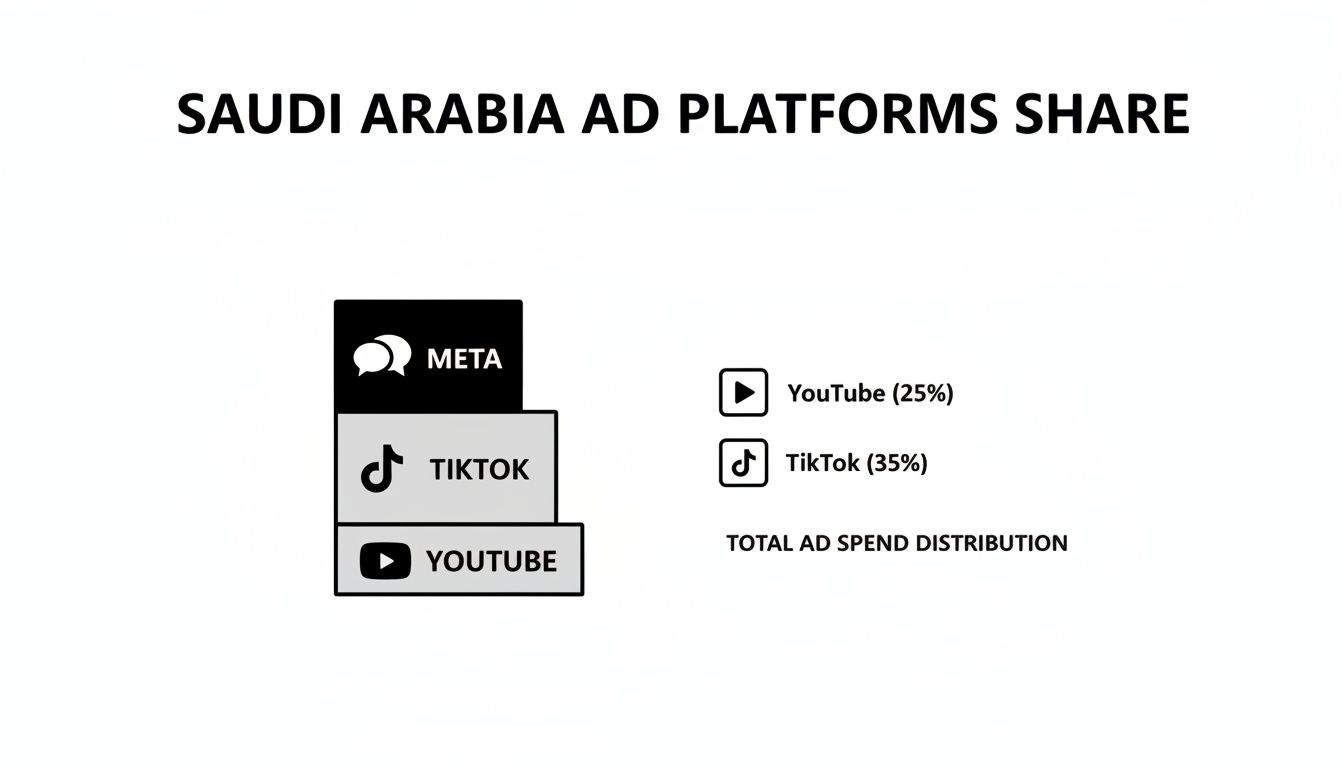 The visual hierarchy is clear: platforms built around video and engaging visuals are where you'll find the most significant audience attention.
To win, your video ads absolutely must be designed for a mobile screen. This means they need to work even with the sound off.
Think bold captions, quick cuts, and getting your message across in the first three seconds. Your job is to break a pattern and earn their attention before they swipe away.
Embrace User-Generated Content
One of the most potent tools in your creative toolbox is user-generated content (UGC). We're talking about the photos, videos, and reviews created by your actual customers.
UGC is pure social proof. It comes from a source people trust—a real person, not a faceless brand.
Think about it: who are you more likely to believe? A polished ad from a corporation or a glowing review from someone you can relate to? By encouraging your customers to share their experiences and then featuring that content in your ads, you build instant credibility. It feels less like an advertisement and more like a genuine recommendation, which is exactly what drives sales and builds lasting loyalty.
Budgeting and Measuring Your Success
Alright, let's get down to brass tacks. We need to talk about the two things that really decide whether your advertising works or not: how much you spend and what you actually get back for it.
Figuring out a budget for your online advertising in South Africa can feel a bit like throwing a dart in the dark, but it really doesn't have to be. It's less about plucking a number out of thin air and more about creating a smart, flexible plan that can grow right alongside your business.
Setting Your Initial Advertising Budget
So, where do you start? What's the magic number?
Honestly, there isn't one. A better way to think about it is this: your initial budget needs to be big enough to let you learn something. For a small to medium-sized business, a good starting point is a budget that can get you at least 50-100 conversions (sales, leads, whatever your goal is) each month. Why? Because this gives the ad platform's algorithm enough data to start properly understanding who your ideal customer is and, more importantly, how to find more of them.
For most businesses here in South Africa, that usually translates to a starting budget of anywhere from R5,000 to R15,000 per month, per platform. The real secret, though, is consistency. It’s much, much better to spend a smaller amount steadily over a whole month than it is to blow a huge budget in a frantic week-long sprint.
A well-planned budget isn't just about capping your spend. It's about giving your campaigns enough runway to gather meaningful data. A tiny, short-lived budget is like trying to pick the winner of the Comrades after the first kilometre—you just don't have enough information to make a good call.
Choosing the Right Bidding Strategy
Once you've got a budget, you need to tell the ad platforms how you want them to spend it. This is where bidding strategies come into play. Think of it as giving your campaign specific instructions on what its main job is.
You'll come across a few common options:
- Cost Per Click (CPC): Simple and effective. You pay every time someone clicks your ad. This is your go-to when the main goal is driving traffic to your website or a specific landing page.
- Cost Per Mille (CPM): "Mille" is Latin for thousand. You pay a flat rate for every 1,000 times your ad is shown (an impression). This is perfect for brand awareness campaigns where you just want to get your name and message in front of as many eyeballs as possible.
- Return on Ad Spend (ROAS): This is a game-changer for businesses focused on the bottom line. You tell the platform what return you expect for every rand you spend. For example, a target ROAS of 5:1 means you're aiming to make R5 in revenue for every R1 you put into ads. This is incredibly powerful for eCommerce.
The right strategy hangs entirely on your objective. Are you trying to build your brand, get website visitors, or drive immediate sales? Your answer points you directly to the right bidding model.
Measuring What Truly Matters
It's easy to get excited by big numbers like clicks and impressions. But let's be honest, they don't pay the bills. In the industry, we often call these "vanity metrics" because they look fantastic on a report but don't always connect to actual business growth.
To really get a grip on your performance, you need to focus on the metrics that directly measure profitability. For any business, it boils down to two key figures:
- Customer Acquisition Cost (CAC): This is the total price you pay, across all your marketing and sales efforts, to get one new customer. The calculation is simple: divide your total ad spend by the number of new customers you won from that campaign. A low CAC is a sign of efficient, effective advertising.
- Lifetime Value (LTV): This is the total amount of money you can realistically expect a single customer to spend with you over their entire relationship with your business. Someone who buys from you multiple times over several years has a far higher LTV than a one-time purchaser.
The golden rule that underpins all successful advertising is that your LTV must be significantly higher than your CAC. If it costs you R200 to bring in a new customer (your CAC), but that customer goes on to spend R1,000 with you over time (their LTV), you've got a healthy, profitable business model.
Nailing this LTV-to-CAC ratio is the absolute key to scaling your advertising sustainably in South Africa. Get this right, and you’re on your way.
Turning Clicks Into Customers
Getting someone to click your ad is a great start, but it’s only half the battle. The real work—and where your profit is actually made—begins after the click. Your ad is the invitation to the party; your landing page and checkout process are the party itself. If the experience is confusing or clunky, your guests will head for the door.
This is where you plug the leaks in your advertising funnel. Remember, you've already paid for that click. Every single visitor who bounces without converting is money down the drain. By optimising this final stretch, you make your entire south africa online advertising strategy work harder and deliver a much better return.
Building High-Converting Landing Pages
Your landing page has one job and one job only: get the visitor to take a specific action. That's it. It has to immediately deliver on the promise you made in your ad, with a clear message and absolutely no distractions.
A great landing page isn’t cluttered with links to your blog, social media, or other parts of your site. It’s a laser-focused environment built for one thing: conversion.
Here’s the anatomy of a landing page that works:
- A Crystal-Clear Headline: This should instantly tell the visitor they’re in the right place by echoing the ad they just saw.
- Compelling Visuals: High-quality images or videos that show your product or service in action and resonate with a South African audience are crucial.
- Benefit-Driven Copy: Don't just list features. Talk about how your offering solves a real problem or makes the customer's life better.
- A Single Call-to-Action (CTA): Make your CTA button impossible to miss. Use strong, action-oriented text like "Get Your Quote Now" or "Shop the Collection."
Streamlining the Checkout Experience
Cart abandonment is the silent killer of online sales. A complicated, slow, or untrustworthy checkout process is one of the top reasons potential customers disappear right at the finish line.
Your checkout is the final hurdle between you and a new customer. Every extra field they have to fill in, every unnecessary click, and every moment of confusion increases the chance they’ll give up.
To cut down on this friction, your mantra should be simplicity. Let people check out as a guest instead of forcing them to create an account. Use tools that auto-fill addresses, and make absolutely sure the entire process is fast and seamless on a mobile phone. Many businesses also get great results by working with specialised lead generation companies to fine-tune their entire conversion path.
Establishing Trust with Local Shoppers
Trust is the currency of eCommerce, especially when dealing with first-time buyers. South African shoppers are savvy and want to feel completely secure before sharing their payment details. Building this trust isn't a "nice-to-have"; it's essential for turning clicks into cash.
Be sure to include these key trust signals:
- Display Local Payment Options: Prominently feature the logos of trusted local gateways like PayFast, Yoco, or Ozow.
- Showcase Customer Reviews: There’s nothing more powerful than social proof. Genuine reviews from other South Africans speak volumes.
- Use Security Badges: Display SSL certificates and other security seals clearly to show customers their personal information is safe.
Your Top Questions About Online Advertising in South Africa, Answered
Getting started with online advertising in South Africa can feel a bit daunting. You've probably got a few questions swimming around, so I've put together some straight-talking answers to the most common queries we hear from businesses on the ground.
How Much Should I Actually Budget for Online Ads?
There's no single magic number, and anyone who tells you otherwise isn't being straight with you. Your budget really hinges on your industry, your specific goals, and how fast you need to see traction.
For a small business just dipping its toes in, a budget between R5,000 and R15,000 per month is a realistic starting point. This is usually enough to run ads on one or two platforms and, crucially, gather enough data to see what’s actually working. Think of this initial spend as an investment in learning. Your goal isn't just to spend money; it's to find a winning formula and then confidently scale up what delivers a solid Return on Ad Spend (ROAS).
How Does POPIA Change How I Run My Ads?
The Protection of Personal Information Act (POPIA) is a big deal for any advertiser in South Africa. At its core, it’s about respecting user privacy. You must have clear, upfront consent before you collect someone's data for marketing, whether that's for an email newsletter or for tracking them with a retargeting pixel.
Think of POPIA as building trust with your customers. You need a clear privacy policy and to be honest about how you handle their information. While platforms like Meta and Google have compliance features baked in, the buck stops with you—your business is ultimately responsible for following the law.
Which Platform is Best for Reaching High-Income Earners?
If you're after high-income professionals or key B2B decision-makers, LinkedIn is often your most direct route. Its targeting is built around professions, job titles, and company size, making it incredibly precise. Don't discount Google Search Ads either; targeting high-intent keywords for luxury goods or specialised professional services can be a goldmine.
What about platforms like Meta (Facebook and Instagram)? You can absolutely reach this audience there, but it requires a bit more finesse. You'll need to get creative with detailed interest targeting, focusing on users who follow luxury brands, show an interest in frequent international travel, or engage with other strong indicators of high disposable income.
Should I Focus on Mobile or Desktop Users?
For almost every business in South Africa, the answer is simple: go mobile-first, always. Mobile internet use dwarfs desktop here, and a massive chunk of eCommerce sales happen on a smartphone. Your ads, your website, and your landing pages must be designed for a small screen—that means fast loading, clear text, and easy navigation.
That said, don't write off desktop completely. It can still be a key touchpoint, particularly for B2B services or big-ticket items where customers do more in-depth research before buying. The best approach? Dive into your own analytics. See where your most valuable conversions are coming from and adjust your strategy to match what the data is telling you.
Ready to put these insights to work and build a real growth engine for your business? At Market With Boost, we live and breathe data-driven ad campaigns that get measurable results. Book a no-obligation discovery call with our team today and let's start unlocking your potential.

Written by
Chief Executive Officer
Chris heads the Boost Marketing team and is also CEO and CTO of Shopstar, with over ten years of digital marketing experience. Before these roles, Chris co-founded MADE Agency, a leading South African digital marketing agency, collaborating with renowned clients like BMW, Red Bull, and Pepsi. He has a deep understanding of eCommerce and a talent for identifying emerging trends.

Scale your performance with data-driven insights
Ready to apply these insights to your business? Hannah can walk you through how we'd approach your specific situation.
Hannah Merzbacher
Operations Manager
Continue Reading
View all Insights
How to Increase Online Sales: A Data-Driven Playbook 2026
Boost your revenue! Learn how to increase online sales with our data-driven playbook. Actionable steps for eCommerce, SaaS & property in 2026....
Pay for Advertising: A Guide to Profitable Growth in 2026
Learn how to pay for advertising effectively. This guide explains pricing models, channels, budgeting, and how to drive real ROAS for your business in...
Advertising in South Africa: A 2026 Growth Guide
Your guide to advertising in South Africa. Get actionable strategies for digital platforms, budgeting, cultural nuances, and CRO to drive growth in 20...